 (This article was first published on LinkedIn)
Everyone’s talking about AI transforming software sales. A conversation with a friend this week got me thinking about how little of that talk is about what actually happens when you put it in front of a real team.
He asked me, half-joking, whether AI was going to make Sales Engineers redundant (he was from a tech vendor that was significantly reducing the size of their field SE team). My honest answer surprised him — and it’s the opposite of most of the hype.
As enterprise technology gets more complex, selling its value gets harder, not easier. An Account Executive can own the relationship and the commercials — but translating genuinely complex technology into a specific customer’s business outcome, and defending it in front of a sceptical CTO or even a CFO (where you have to articulate how their spend with you translate into real business value in tangible £/$ terms for them), isn’t something a sales rep’s charm or an AI generated slide deck can carry. That’s the Sales Engineer’s main job (out of many). And the more complex the technology, the more deal-critical that role becomes.
Which is exactly why AI doesn’t threaten it. The thing AI is weakest at — deep contextual technical judgment under scrutiny, especially when it has to hold across multiple threads at once — is the very thing rising complexity demands more of.
Having spent the last 15 years driving various SE-led sales initiatives, with the last few years focused on figuring out how to meaningfully expand their reach using AI, here are my thoughts — where it can earn its place, and where it likely won’t:
Where it moves the needle:
→ Opportunity qualification. Not “the AI scores the deal,” but giving Account Executives (AEs) and Sales Engineers (SEs) a fast, structured second opinion based vast sums of background dat that surfaces the questions they’d otherwise ask three meetings too late. Cleaner qualification, earlier.
→ Account planning and business-case generation. This is where value engineering and AI meet. Standardised TCO/ROI logic plus an agentic layer means a seller can generate a defensible, customer-ready business case conversationally — instead of waiting days for a specialist. That’s a cycle-time change, not a cosmetic one.
→ Freeing senior SEs from the low-judgment grind — first-draft RFP responses, meeting write-ups, boilerplate architecture docs — so they spend more time on the things only they can do: reading the room in a tough technical negotiation, earning a sceptical CIO or CTO’s trust, designing a custom solution nobody’s built before…etc.
Where the hype oversells it:
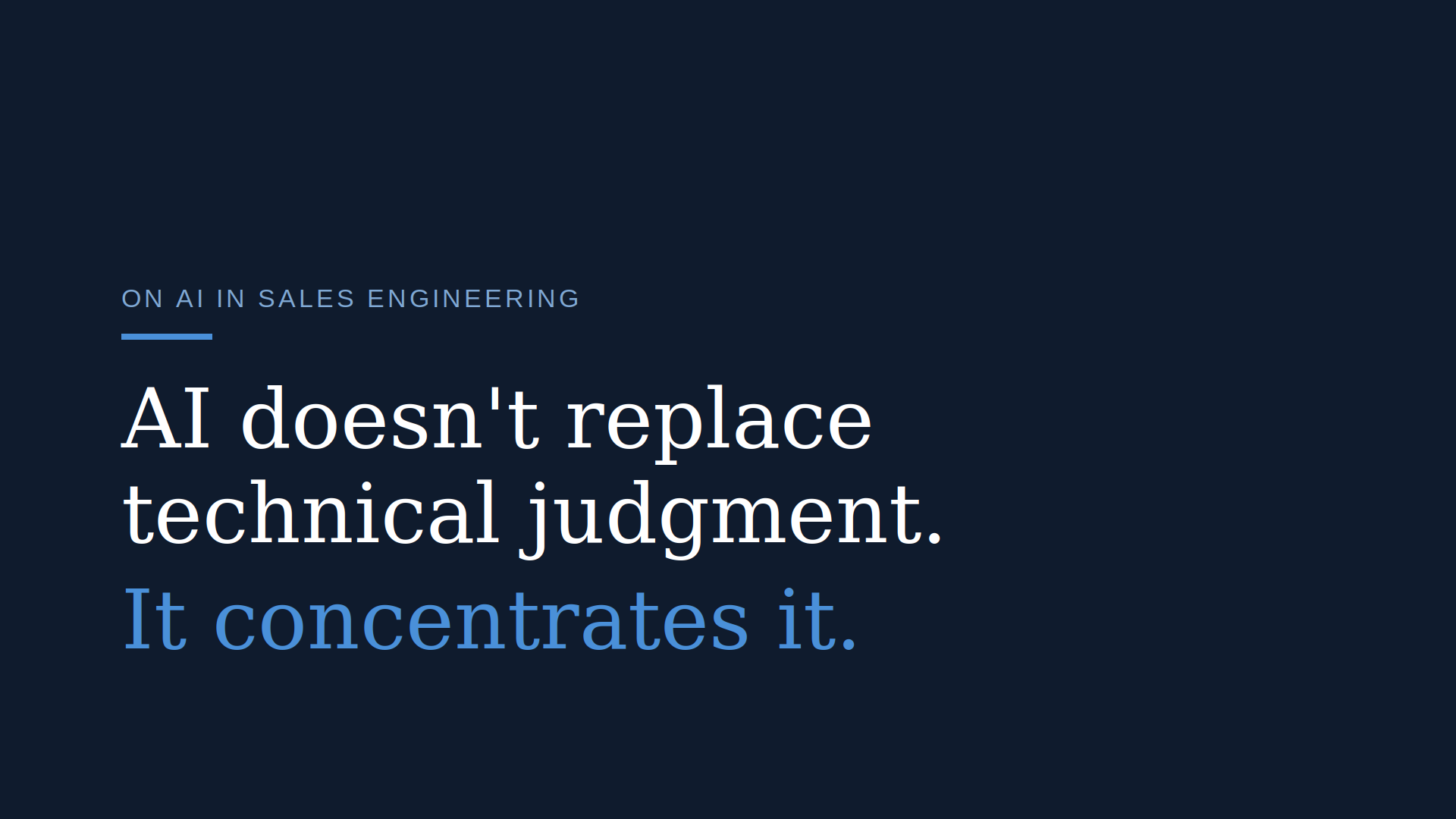
→ It doesn’t replace technical judgment — it concentrates it. The teams that got real value treated AI as leverage for their best people, not a substitute for expertise.
→ Adoption is a leadership problem, not a tooling problem. The technology was rarely the blocker. Operating rhythm, trust, and “show me how it actually makes my day easier” were. (last one is super important)
And here’s the mistake I’d warn against: treating AI as a reason to cut SE headcount or dilute SE expertise. I’ve seen organisations do exactly this — and it’s precisely backwards. If AI raises the value of technical judgment, thinning the team that supplies it doesn’t capture the efficiency; it removes the very thing the efficiency was meant to amplify. You end up with faster tooling and no one senior enough to wield it well.
So no — I don’t think AI makes great SEs redundant. I think it makes them more valuable, and it makes the average ones easier to spot.
One thing that keeps me honest on all of this: I’ve built a few production ready AI-native apps hands-on with Anthropic’s API & Claude Code. Staying close to how these tools actually behave in production — where they’re brilliant, and where they quietly get things wrong — changes how you lead their adoption. It’s a very different perspective from managing AI at arm’s length or based on distant feedback, or even based on your own experience inside a POC bubble.
My read: the SE function is about to change more in the next two years than it has in the last ten — who win will be the ones who’ve actually had their hands dirty: not just buying licences or vibe-coding a demo or a proof-of-concept, but building something thats real — usable and scalable in real life and applying that learning to their transformation approach.
Curious what others leading technical GTM teams are seeing. What’s genuinely working for you — versus what’s just a good demo?


One Comment